Storytelling as a Tool for Building Belief
Stephen
February 10, 2026
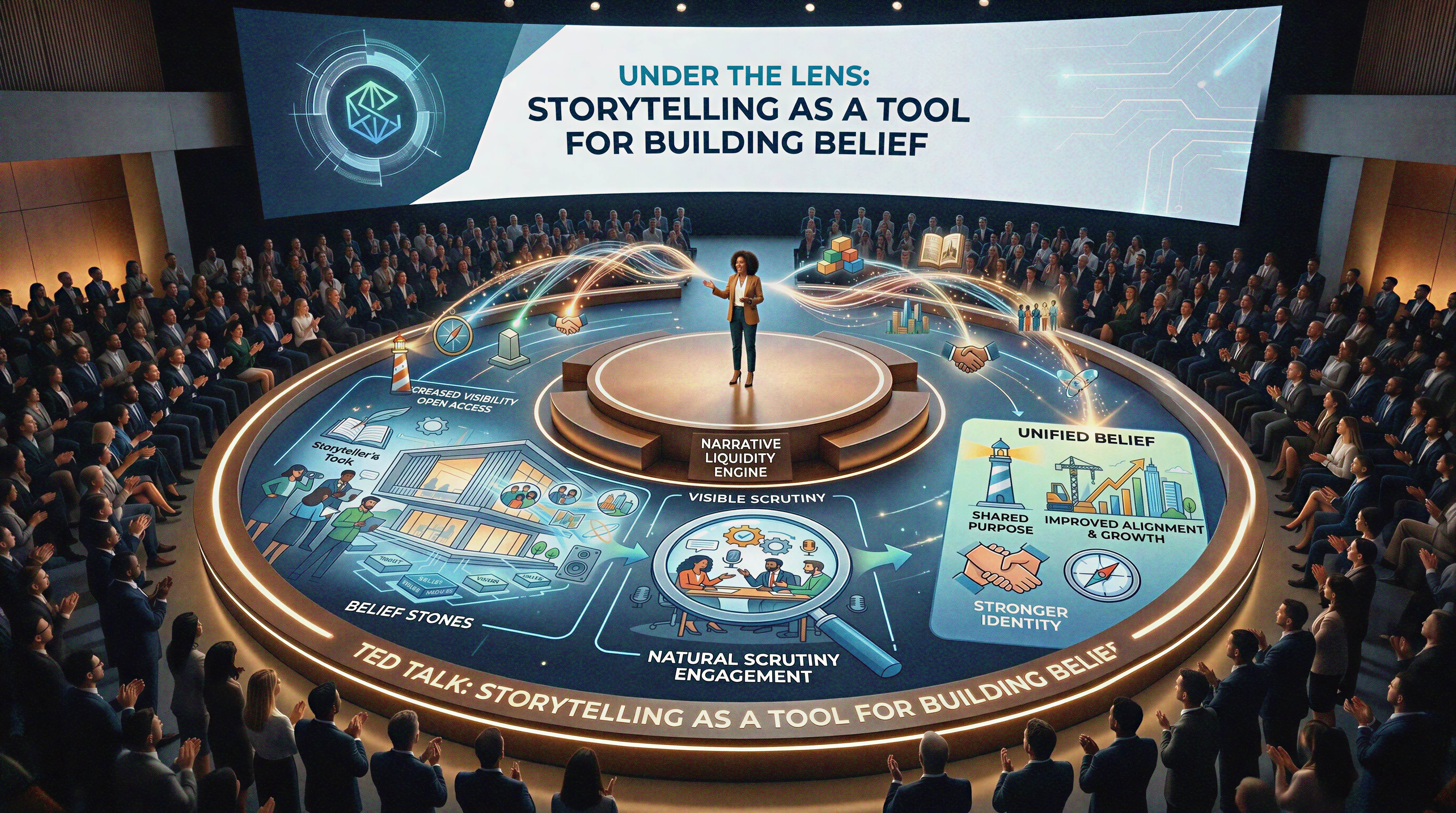
People do not believe in brands because of data. They do not form loyalty because of product specifications. They do not become advocates because of quarterly results. People believe because of stories. And in a world saturated with information, the ability to build belief through narrative is not a soft skill—it is the most strategically valuable capability a brand can possess.
The science supports this unequivocally. The question is whether your organisation is treating storytelling as a strategic discipline or as a decorative afterthought.
The Neuroscience of Belief
In 2012, Princeton neuroscientist Uri Hasson published research that fundamentally changed how we understand communication. Using fMRI brain imaging, Hasson demonstrated that when a speaker tells a story effectively, the listener's brain activity begins to mirror the speaker's. He called this phenomenon "neural coupling"—the literal synchronisation of brain patterns between storyteller and audience.
This is not metaphor. It is measurable biology. When someone hears a well-constructed narrative, their brain does not simply process information. It simulates the experience being described. The motor cortex activates when the story involves action. The sensory cortex responds when the story describes textures or colours. The emotional centres engage when the story carries emotional weight.
This is why stories persuade in ways that facts alone cannot. A data point lands in the prefrontal cortex—the analytical brain. A story lands everywhere. It creates a full-brain experience that forms the neurological foundation of belief.
Harvard Business Review explored this phenomenon in their widely cited article "Why Your Brain Loves Good Storytelling." The piece examined research by neuroeconomist Paul Zak, who found that narratives trigger the release of oxytocin—the neurochemical associated with empathy, trust, and social bonding. Zak's research demonstrated that people exposed to character-driven stories were significantly more likely to cooperate, to donate to charity, and—critically for brands—to take action aligned with the story's emotional arc.
The implication for brand communications is profound: if you want people to believe in what you stand for, you do not give them a fact sheet. You give them a story.
Why Facts Fail and Stories Succeed
Stanford Graduate School of Business conducted research that has become foundational in communications strategy. In controlled experiments, researchers found that stories are up to twenty-two times more memorable than facts alone. When information is embedded within a narrative structure—with characters, tension, and resolution—retention increases dramatically compared to the same information presented as standalone data points.
The Journal of Marketing Research published complementary findings on what researchers termed "transportation theory." When an audience becomes "transported" into a narrative—when they lose themselves in the story—their resistance to persuasion drops significantly. The critical defences that people normally deploy against marketing messages—scepticism, counter-arguing, source evaluation—diminish when the message arrives as a story rather than a sales pitch.
This has direct financial implications. Every brand spends resources trying to overcome audience resistance. Advertising fights for attention. PR fights for credibility. Digital marketing fights for engagement. But storytelling, done well, bypasses the fight entirely. It does not argue against resistance. It dissolves it.
At Conversarii, this insight sits at the centre of our approach to Engineered Narrative Liquidity. We do not build campaigns designed to overcome audience scepticism. We build narrative architectures designed to create genuine belief—stories that flow coherently across every touchpoint, every channel, and every stakeholder interaction, building cumulative trust rather than fighting for momentary attention.
The Coherence Imperative
A single powerful story is valuable. A coherent narrative system is transformative. The distinction matters enormously.
The Edelman Trust Barometer—the world's most comprehensive study on institutional trust—has consistently found that trust is not built through individual messages but through consistent patterns of communication. When what an organisation says in one context aligns with what it says in every other context, trust compounds. When there are contradictions—even subtle ones—trust erodes, and it erodes faster than it builds.
This is where most organisations fail at storytelling. They may craft an excellent brand story for their website. A compelling narrative for investor presentations. An engaging tone for social media. But these stories exist independently, developed by different teams with different briefs and different strategic frameworks. The result is not a coherent narrative. It is a collection of stories that occasionally contradict each other.
Deloitte's 2024 Global Marketing Trends research found that organisations maintaining consistent narratives across all stakeholder touchpoints significantly outperformed those with fragmented messaging. The performance gap was not marginal—it represented meaningful competitive advantage in customer acquisition, retention, and lifetime value.
Coherence does not mean repetition. It means structural alignment. Every story your brand tells—to customers, to investors, to employees, to media, to partners—should be a different expression of the same foundational narrative. Different in form, identical in substance. Different in channel-specific execution, unified in strategic direction.
Storytelling as Strategic Architecture
The most common mistake organisations make with storytelling is treating it as a content exercise. They hire writers. They produce articles, videos, and social posts. They create "content strategies" that are really just production schedules.
This fundamentally misunderstands what strategic storytelling requires. A story is not content. A story is a structure. It has a protagonist (your audience, not your brand). It has a challenge (the problem they face). It has a journey (the transformation they undergo). And it has a resolution (the outcome they achieve).
McKinsey's research on the business value of design—which extends to narrative design—found that organisations treating design as a strategic discipline rather than a cosmetic function outperformed industry benchmarks by substantial margins. The same principle applies to storytelling. When narrative is treated as strategic architecture rather than content production, it becomes a genuine business asset.
This is why storytelling cannot be siloed. If your PR team tells one story, your creative team tells another, and your digital team tells a third, you do not have a narrative architecture. You have narrative chaos. And narrative chaos does not build belief. It breeds confusion.
The Compound Effect of Belief
Belief, once established, compounds. A customer who believes in your brand does not need to be re-convinced with every interaction. An investor who believes in your narrative does not need to be re-sold with every quarterly report. An employee who believes in your mission does not need to be re-motivated with every all-hands meeting.
This compounding effect is the most financially significant aspect of storytelling as a strategic tool. Every investment in narrative coherence pays dividends across every subsequent interaction. The cost of acquiring belief decreases over time while the value of that belief increases.
Conversely, every inconsistency in narrative—every moment where the story fractures—resets the compounding clock. Trust that took months to build can be undermined by a single contradictory message. The Edelman research is unambiguous on this point: trust is asymmetric. It takes far longer to build than to destroy.
This asymmetry makes narrative coherence not just a communications preference but a risk management imperative. Organisations with fragmented storytelling are not just missing an opportunity—they are carrying a liability.
From Storytelling to Belief Systems
The most powerful brands in the world are not selling products. They are maintaining belief systems. Their customers do not just buy from them—they believe in them. Their employees do not just work for them—they believe in the mission. Their investors do not just fund them—they believe in the vision.
These belief systems are built entirely through narrative. Not through any single story, but through the accumulated weight of thousands of coherent stories told across years, across channels, and across stakeholder groups. Each story reinforces the others. Each interaction deepens the belief. Each touchpoint adds another layer to a narrative architecture that becomes, over time, unassailable.
This is what strategic storytelling actually delivers. Not content. Not campaigns. Not messaging. Belief. And belief, in a world where attention is scarce and trust is scarcer, is the most valuable asset any brand can build.
The question is not whether your organisation tells stories. Every organisation does. The question is whether those stories are building a coherent belief system—or quietly undermining one.
References & Sources
- Princeton University (Uri Hasson) — "Brain-to-Brain Coupling: A Mechanism for Creating and Sharing a Social World" (2012)View Source
- Stanford Graduate School of Business — "Harnessing the Power of Stories" (2014)View Source
- Harvard Business Review — "Why Your Brain Loves Good Storytelling" (2014)View Source
- Edelman — "2024 Edelman Trust Barometer" (2024)View Source
- Journal of Marketing Research — "The Persuasive Power of Narratives" (2018)View Source
- Deloitte — "2024 Global Marketing Trends" (2024)View Source
- McKinsey & Company — "The Business Value of Design" (2018)View Source
About the Author
Stephen is a Partner at Conversarii focused on narrative and brand transformations for impact
Like This Thinking?
Get more insights delivered to your inbox